
Private Jet Charter Pricing: The Truth About Instant Online Estimates
Updated: Apr 13
In an era where we can summon a car, a five-course meal, or a cross-continental flight with a single tap on a smartphone, the desire for instant gratification has naturally bled into the world of private aviation. You have likely encountered them: sleek "instant quote" calculators that promise a definitive price for a journey from London to Palma or Teterboro to Palm Beach in milliseconds.
While these tools are excellent for providing a "ballpark" figure or helping you understand the entry point for a specific route, they often fall short of the precision required for a complex international itinerary. More importantly, most online estimates are strictly guide prices - useful for setting a minimum expectation (and for preventing the mild shock that can occur when you realise a “from £X” number has the structural integrity of a soufflé), but not reliable enough to be treated as a bookable, all-in figure.
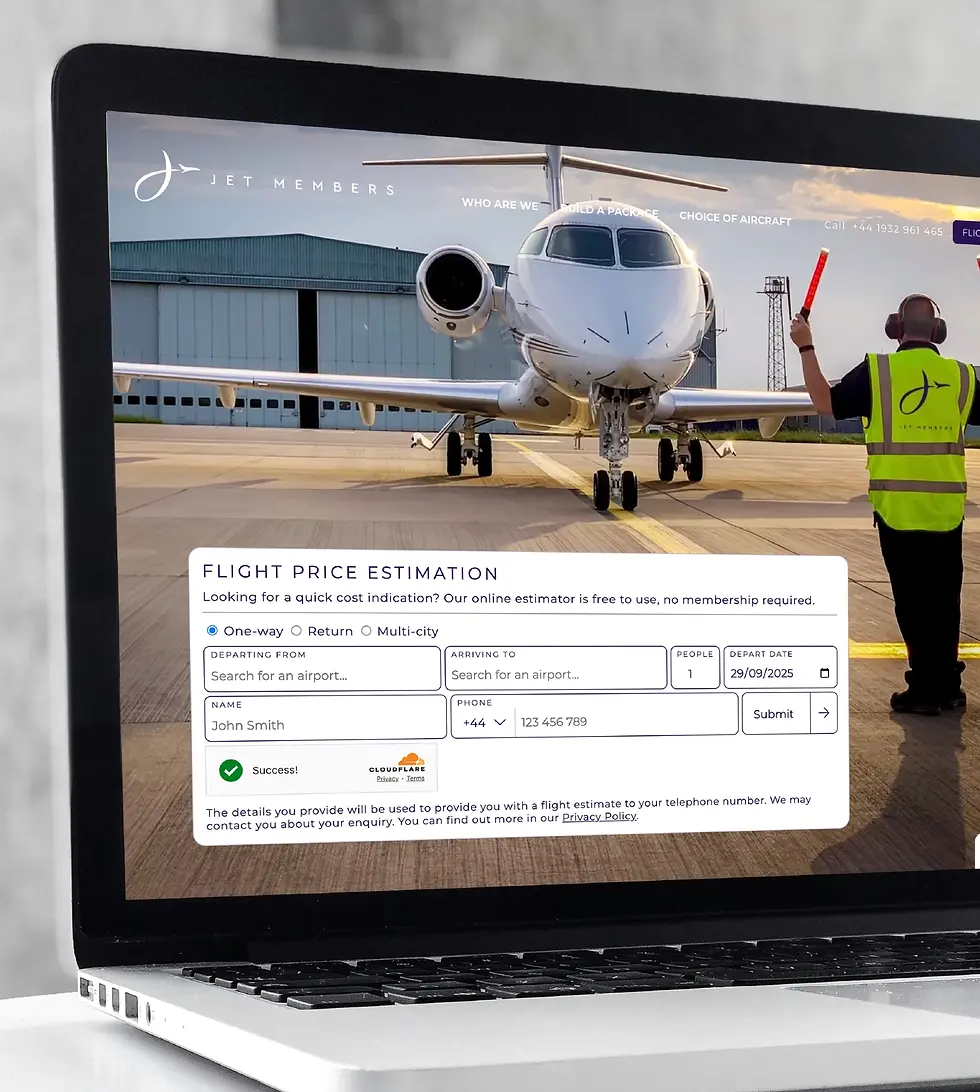
At Jet Members, we believe in transparency. To truly understand why an online estimate might differ from your final charter invoice, one must look behind the curtain at the myriad of variables that a standard algorithm simply cannot compute.
The Algorithm vs. The Reality
An online calculator typically relies on a fixed set of data: the estimated flight time multiplied by a generic hourly rate for a specific aircraft class. While this provides a logical starting point, it ignores the fluid nature of the aviation market. If you were to look at private jet costs via 10 example trips from London, you would see that no two journeys, even those of similar distance, are priced identically.
The reality is that a private jet is not a static product sitting on a shelf; it is a mobile asset with its own schedule, crew requirements and maintenance cycles. An algorithm rarely knows if the aircraft is already positioned at your departure airport or if it needs to fly in from three countries away, incurring 'positioning costs' that can add thousands to the final total.
The "Hidden" Components of an Accurate Quote
To understand why a bespoke quote is necessary, we must break down the components that actually build the price. Typically, your quote will cover the aircraft’s billable flight hours (ranging from £1,200 to over £10,000 per hour depending on the airframe), but the complexities lie in the auxiliary costs.
1. Airport Handling and Landing Fees
Not all runways are created equal. If you are flying into a major hub like London Heathrow or Paris Le Bourget, the landing and handling fees are significantly higher than at a regional airfield. Online tools often use an "average" handling fee, which may leave you under-quoted for premium FBO (Fixed Base Operator) services. Furthermore, if you are planning a private jet London to Italy in 2026, you must account for the specific best-use airports that balance cost with proximity to your final destination.
2. The Regulatory Landscape: The French Passenger Tax
A prime example of why instant estimates fail is the ever-changing regulatory environment. As of March 2025, France introduced a specific passenger tax on private jet departures. Depending on the distance of the flight and the type of aircraft, this can add anywhere from €210 to €2,100 per passenger. Most online calculators are not updated in real-time to reflect these legislative shifts, meaning your "instant" price could be thousands of Euros off before you even board.
3. Crew Logistics
If your flight requires an overnight stay, the charterer is responsible for the crew’s accommodation, meals and transport. If the aircraft needs to stay on the ground for several days to facilitate your return, hangarage or parking fees apply. An algorithm struggles to predict these logistical nuances without a detailed conversation about your itinerary.

The Classification Conundrum: Understanding 'Super Light' Jets
One area where online tools often confuse clients is in aircraft classification. Many platforms group aircraft into broad 'Light' or 'Midsize' categories, which can lead to unrealistic expectations regarding cabin space and price.
At Jet Members, we distinguish a specific tier known as Super Light Jets. This category includes high-performance, efficient aircraft such as the Phenom 300, Citation XLS (560XL series), Learjet 45/75 and the new Citation Ascend. These aircraft offer a "best of both worlds" scenario: the agility and cost-effectiveness of a Light Jet with the stand-up cabin comfort and range of a larger aircraft.
However, it is worth noting that “what aircraft is it?” is only half the question; “what condition is it in, and how has it been operated?” is where the real-world experience (and occasionally the real-world invoice) begins to diverge from the tidy assumptions of an online tool. Aircraft quality is not determined by age alone, and a newer registration is not a substitute for proper due diligence. When assessing suitability, you should also consider:
Total hours and cycles: A well-managed aircraft with higher utilisation can be superb, an under-used one can also be superb - the point is that hours flown, cycles and maintenance cadence matter more than the calendar year on a brochure.
Refurbishment and interior history: A thoughtful cabin refresh, updated avionics and a strong maintenance record typically tell you more than a headline 'year of manufacture'.
Operational patterns: Consistent corporate flying with stable crews and predictable schedules can look very different (operationally and cosmetically) from aircraft that spend their lives doing high-frequency, short-sector work.
When comparing the Phenom 300 vs. Citation XLS, the price difference might be negligible on an online calculator, but the operational suitability for a specific short-runway airport in the Alps might make one significantly more expensive to operate than the other.

Why Seasonality and External Events Matter
Charter pricing is subject to the laws of supply and demand. If you are booking a private jet for a ski trip, prices will naturally peak during school Half Terms and Christmas. Conversely, you might find value in the Half Term Empty Leg schedule if your dates are flexible.
External disruptions also play a role. For instance, the French ATC strikes in late 2025 or the introduction of the Entry/Exit System (EES) at European borders can alter routing and ground time. A human broker will anticipate these issues and adjust the quote to ensure you aren't hit with "surprise" surcharges for rerouting or extra fuel due to holding patterns.
Fixed Hourly Rates vs. Market Pricing
For frequent flyers, the choice often comes down to the structure of their program. Should you opt for a Jet Card with a fixed hourly rate, or stick to the on-demand charter market?
A fixed hourly rate offers the ultimate "instant" quote because the price is pre-negotiated. However, as we explore in our guide on fixed hourly rates vs. market pricing, there is a "decision boundary." In a soft market, on-demand charter is often significantly cheaper than a fixed card rate. In a peak market, the card protects you from price surges. An online estimate cannot tell you which of these is the better financial move for your specific flight: only an advisor can.

The Technical Variables: Performance and Payload
Finally, there is the matter of physics. An online calculator assumes the aircraft can carry all your passengers and luggage on the chosen route. However, if you are flying a full cabin of eight passengers with heavy ski gear from a high-altitude airport in the summer, the aircraft may have 'weight and balance' restrictions. This might necessitate a larger aircraft or a refueling stop - both of which increase the cost.
If you are interested in the technical nuances of how cabin size affects your choice, viewing a cabin cross-section of an Ultra Long Range Jet can help illustrate why a larger, more expensive airframe is sometimes a necessity rather than a luxury.
Why a Bespoke Quote is Your Best Protection
At Jet Members, we understand the appeal of a quick number. However, our role as your flight department is to provide a price that is "firm" and inclusive of all the variables mentioned above. When we provide a quote, we have already accounted for:
Current Fuel Surcharges: Which fluctuate daily.
De-icing Funds: Vital for winter travel to ensure no surprise invoices post-flight.
Catering Preferences: Ensuring your specific requirements are met without hidden fees.
Operational Contingencies: Such as navigating blackout dates or peak event restrictions.
The "truth" about instant online estimates is that they are a tool for research, not a tool for booking. For a journey that is as seamless as it is spectacular, the human element remains the most critical component of the pricing process.
This is also where automated apps (and, increasingly, AI-driven quoting tools) meet their natural ceiling. They are quick, consistent and entirely unbothered by nuance, which is marvellous right up until your trip stops behaving like a spreadsheet. In the event of:
Weather disruption: re-routes, slot constraints, de-icing requirements and knock-on crew duty limitations can appear quickly.
Mechanical issues (AOG): an aircraft swap is not simply “pick another one”; it is checking licences, availability, positioning, baggage capacity, cabin suitability and the impact on departure times.
Crew delays or operational timing changes: duty time, rest requirements and airport curfews can turn a small shift into a meaningful re-plan.
A personal Account Manager does not just “find another quote”; they oversee the moving parts, speak to operators, pressure-test options and solve the human problems that computers tend to file under “unexpected”. AI will likely improve (and we welcome anything that reduces friction), but it cannot replace the value of someone personally overseeing your trip end-to-end, because reassurance, judgement and accountability are not features you can toggle on in an app.
So, if you are planning your next trip: be it a spring route from London or a long-range mission, we invite you to speak with one of our Flight Directors. We don't just give you a number; we provide a fully managed aviation solution tailored to your exact needs.

Comments